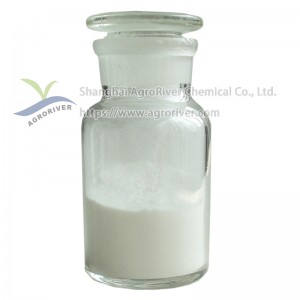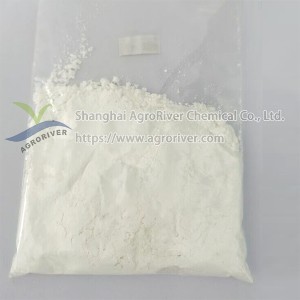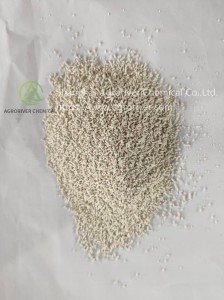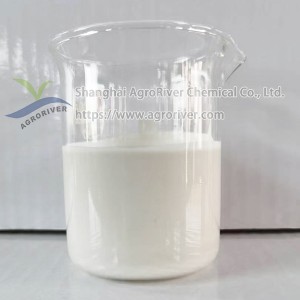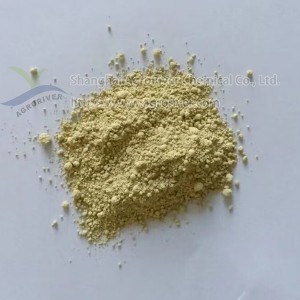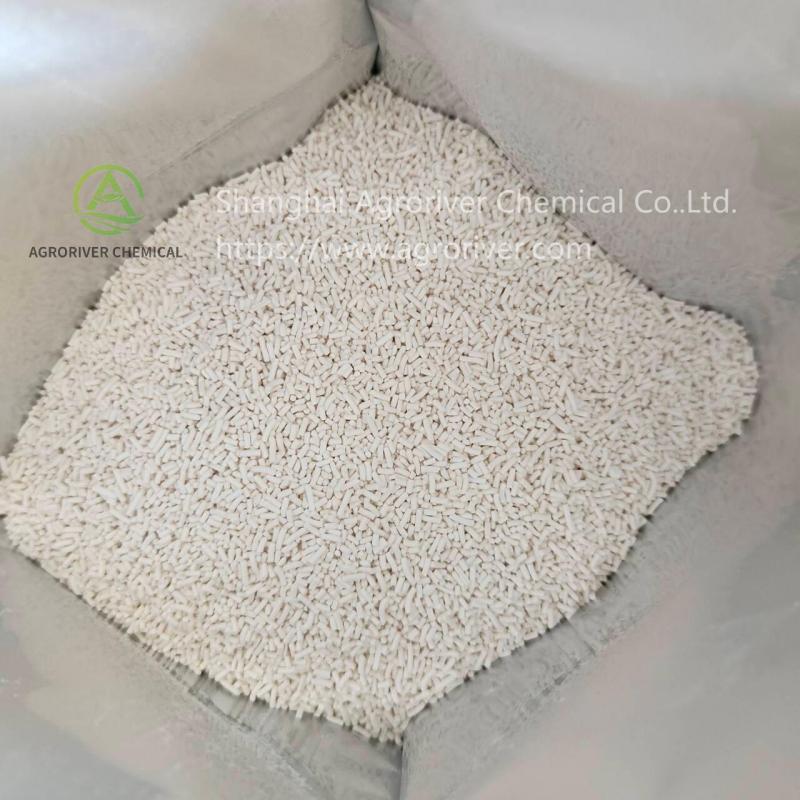
Trifloxystrobin 25% WG
Products Description
Basic Information
Common Name: Trifloxystrobin
CAS No.: 141517-21-7
Synonyms: Methyl (E)-2-(methoxyimino)-2-[2-[[[[(E)-1-[3-(trifluoromethyl)phenyl]ethylidene]amino]oxy]methyl]phenyl]acetate; CGA 279202; Flint; Tega
Molecular Formula: C₂₀H₁₉F₃N₂O₄
Agrochemical Type: Fungicide
Mode of Action: inhibiting mitochondrial respiration and interfering with energy production. It is a broad-spectrum, systemic fungicide and will kill a wide variety of fungal pathogens on contact and after absorption. Trifloxystrobin is referred to as a strobilurin fungicide because it blocks electron transfer at the Qo site of cytochrome bc1, causing the pathogen to stop growth and die quickly.
Formulation: Trifloxystrobin 25% WG; Trifloxystrobin 50% WG; Trifloxystrobin 25% SC; Trifloxystrobin 50% SC; Trifloxystrobin 98% TC.
Specification:
|
ITEMS |
STANDARDS |
|
Product name |
Trifloxystrobin 25% WG |
|
Appearance |
Off-white to light brown granules |
|
Content |
≥25% |
|
pH |
6.0~8.0 |
|
Water insolubles, % |
≤ 3.0% |
|
Suspensibility, % |
≥ 80% |
|
Wet sieve test |
≥ 98% (passing 45μm) |
|
Solution stability |
Qualified |
|
Stability at 0℃ |
Qualified |
Application
Trifloxystrobin is a broad-spectrum systemic strobilurin fungicide with preventative and curative activity. After being absorbed by green plants, mitochondrial respiration is inhibited, and the electron transfer at the Qo site of cytochrome bc1 is blocked in the presence of oxygen, forming ATP depletion, and the accumulation of this inhibition destroys the fungal cell membrane and stops mycelial growth. Suitable for controlling plots dominated by powdery mildew, rusts, and leaf spots;
It can also be used as a seed treatment fungicide; It can also be used as a protective agent for cereals, pome fruits, grapes, peanuts, bananas, vegetables, and other crops; When treating crops, the systemic and translaminar properties allow the residual chemical to be rapidly uptaken by the leaves and redistribute by superficial vapour movement, providing long-lasting protection and effectively reducing disease incidence; It can also be used as a mixture partner with triazoles or SDHIs for resistance management. Because it has good rainfastness, it provides reliable control under various weather conditions.
For cereal disease control, the dosage is 100~187g active ingredient/ha. For fruit and vegetable disease control, the amount is 50~140g active ingredient/ha, and the orchard is 100~200g active ingredient/ha.
Do not apply more than the recommended dosage rates continuously, because the pathogen will easily develop resistance to this chemical.